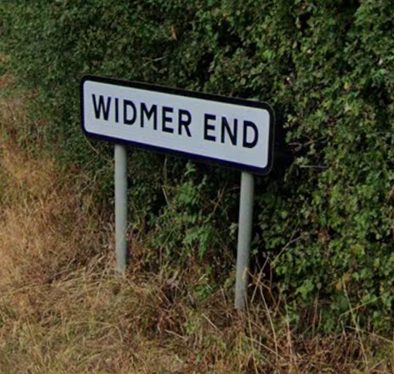
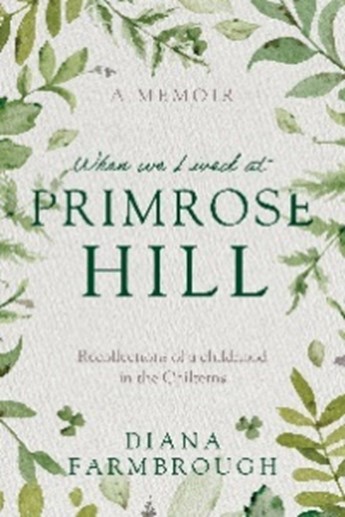
My book is about the period just after the Second World War when I was growing up in Widmer End. Upon reflection I realise that those years living at Primrose Hill, it seemed the sun shone all summer. We were surrounded by familiar faces, and I enjoyed a happy childhood
Sharing stories from my early life has given me much pleasure – and this has been returned over and again by my readers. Many say that my book has prompted memories of their own childhood.
To live in such a community as Widmer End was a privilege. Diana Farmbrough (Author)
The following is an extract from Diana’s article in the Bucks Free Press on 1st November 2023:
My parents bought a between-the-wars bungalow on Primrose Hill. It was called Finchers, and we lived there with my Mum, Sybil, and Dad, Pete, sister Mary, who was one year younger than me, and our mother’s grandfather, who was always called Grampy Rackstraw.
I lived at Primrose Hill for 10 years. Our parents knew the names of everyone who lived there and their families. Janes’ Farm was at the bottom of the road, and as the hill levelled out, there were five houses on the left and a few more on the right-hand side of the road, surrounded by open fields and thick hedges. At the top of the road were three more farms, Primrose Hill Farm, Hawbushes Farm and Primrose Farm, owned by the Stevens family.
Finchers was the last of three 1930s bungalows on the right after Janes’ orchard. First the Tilley family, then the (Pete) Saunders family, a spare plot of land and then Finchers, our home. Our neighbours on the far side were, like us, a three-generation family of Saunders’. Dolly Corbet’s dog boarding kennels were beyond and the last house on the right was the Pearce family, who still harvested their cherry orchard.
In those days there was very little traffic, we children would play hopscotch or skipping in the road with the three Bennell children: Susan, a pretty girl a year older than me; Jimmy, and Johnny – both younger and with red hair. Our Primrose Hill gang included Alan Tilley, a tubby boy, who always wore clean and tidy clothes.
The Bennell family lived in the first house on the left-hand side of the road. They had a large garden that stretched down into the valley between Primrose Hill and Widmer End. Like us, they kept rabbits, and chickens but had enough land to keep pigs as well and a large vegetable garden.
Just up the road from the Bennells was Mr and Mrs White. He was a Special Constable. They had a telephone and, most importantly, they would allow us to use it, but only in an emergency.
We children would sometimes wander to the top of the road where footpaths led across fields in three directions, each with a stile we could treat as a climbing frame and watch any interesting farming activity that happened to be going on.
On the corner of Primrose Hill and Windmill Lane was a wooden shack behind a high hedge occupied by old Mrs Green. She was a recluse and we watched her with fear and curiosity in equal measure. We tried not to stare, but in all weathers she wore a fur coat, fur boots and felt hat and carried a tattered leather handbag. We could hear her talking to herself as she came along the road, gazing solidly at the road in front of her. We could see her dirt-engrained hands, thick make-up, and haphazard lipstick. The effect was quite frightening. Our parents encouraged us to feel sorry for her, but we continued to be cautious and watch her with uneasy fascination.
You can buy Diana’s book from https://www.troubador.co.uk/ or download the eBook on Amazon.
Available: Hardback (ISBN: 9781803137001), £16.99 from
Troubador Publishing Ltd. and Blackwell Ltd.
and eBook: (eISBN 9781805145615) £5.99 through Amazon UK
 Widmer End Residents' Association